

How did the literati of the Roman Empire perceive Christianity in its infancy? To find out, I’ve taken a tour of six authors from the second century.
From Pliny the Younger’s letters to the Emperor Trajan to the scathing critique of Christianity by the philosopher Celsus, we will see how this strange, fledgling sect was seen by its elite, literary critics – and why they took the time to respond to it.
1. Pliny the Younger
Our first writer is the Roman lawyer, Pliny the Younger, who was the governor of Bithynia-Pontus (in modern-day Turkey) from around 110-113 CE.
While he was governor, Pliny wrote to the Emperor Trajan to work out what to do with a frustrating group he calls Christiani. The full correspondence is too long to be cited here.1 Yet it contains a wealth of fascinating information about Christianity.
Consider, for example, the question of Christian praxis. When Pliny came across the Christiani, he interrogated them, and they told him about what they got up to:
‘…. they were in the habit of meeting on a certain fixed day before it was light, and of singing in alternate verses a hymn to Christ as to a god, and of binding themselves by a solemn oath, not to wicked deeds, but never to commit any fraud, theft, or adultery, never to falsify their word, nor to deny a pledge when they were called upon to deliver it up. After this it was their custom to separate, and then reassemble to partake of food—but food of an ordinary and innocent kind.’
Although Pliny is writing in the 110s CE, he claims to be basing this information on interviews from ex-Christians who had recanted up to twenty years ago. It is fascinating, then, that this letter may give us a glimpse into first-century Christianity.
Their practices seem to tally well with what we know from early Christian literature: the meeting of a ‘fixed day’ may refer to Sunday, the ‘Lord’s day’, while the resumption of a communal meal could refer to the eucharist, which in its earliest moments, took the form of a more ordinary meal rather than a ritual one.2
Most fascinating of all, Pliny says that they were in the habit of ‘singing in alternate verses a hymn to Christ as to a god.’ The fact that the Christians sing hymns to Christ ‘as though (quasi) to a god’ seems to imply that Christ was a mortal who had assumed divine status. If not, Pliny would have written, ‘Christos deo’: to the god Christ.3
Antiphonal Singing in the Roman World
Singing in alternate verses – what music theorists call ‘antiphony’ – was a common part of Roman religious practice. One example is the poet Horace’s Centennial Hymn (Carmen Saeculare), which was commissioned by Augustus for the Centennial Games in 17 BCE. In the verses, a semi-chorus of youths and maidens would sing to the god Apollo and his sister Diana, in turn.
It is interesting to speculate what an early Christ-antiphon might have looked like. Scholars have long pointed to Phil. 2:5-11 and Col. 1:15-20 as potential candidates for a Christ hymn. While there is no evidence that these ‘hymns’ were sung as antiphons, they do address Christ’s greatness, and may provide some context for the content involved in early Christian hymn-singing.
Sharing a communal meal, singing a religious hymn, making vows to live decently: none of this seems out of line with ancient Roman religious practice.
What then was Pliny’s problem with these Christians, so much so that he tortured them and – in some cases – put them to death? We get to the nub of Pliny’s political concerns towards the end of his letter:
‘[With the return of Christians to Roman religion it] is certain at least that the temples, which had almost become deserted, are now beginning to be visited again; and the sacred rites, after a long interlude, are again being revived. There is a general demand for sacrificial animals, for which up to now only rarely were purchasers found. From this it is easy to imagine that a multitude of people may be reclaimed from this error, if a door is left open for them to change their minds.’
Here we gather that Pliny’s problem is not only religious, but economic. It is not merely that Christian converts stopped attending the Temple, they have also stopped eating meat sacrificed to idols. Given that a ‘multitude of people’ were becoming Christians – in Pliny’s own words, in both ‘the villages and cities’ – this would have presented a serious problem for Pliny’s non-Christian populace.
The Temples were a significant hub of economic activity, supplying work for priests and lay-people alike. Local craftsmen made votive offerings and images of the gods, offered in thanksgiving in exchange for favours, and farmers sold animals for ritual sacrifices. By refusing to partake in this activity, Christians posed a serious threat.
That this was not an isolated complaint is confirmed by a parallel in Acts 19. Further south in Ephesus, there was a riot when the silversmith and idol maker, Demetrius, was put out of business by the missionary work of Paul. In that scene, the two essential concerns are the same here: the fact that Artemis (or the Roman gods) will not be worshipped, and that as a result the wealth of the people will vanish.
Trajan’s reply to Pliny confirms that Christiani were perceived as a threat. He commended Pliny’s course of action: they should not be searched out, and should be given a chance to repent (by worshipping the Roman gods again). But for any Christians who were denounced and refuse to repent, they should be put to death.
2. Tacitus
Our second reference to early Christianity comes from Pliny’s friend, Tacitus. Among his many writings, Tacitus is well-known for his Annals, which documents the rise (and fall) of the Julio-Claudian dynasty, which came to an end with Emperor Nero.
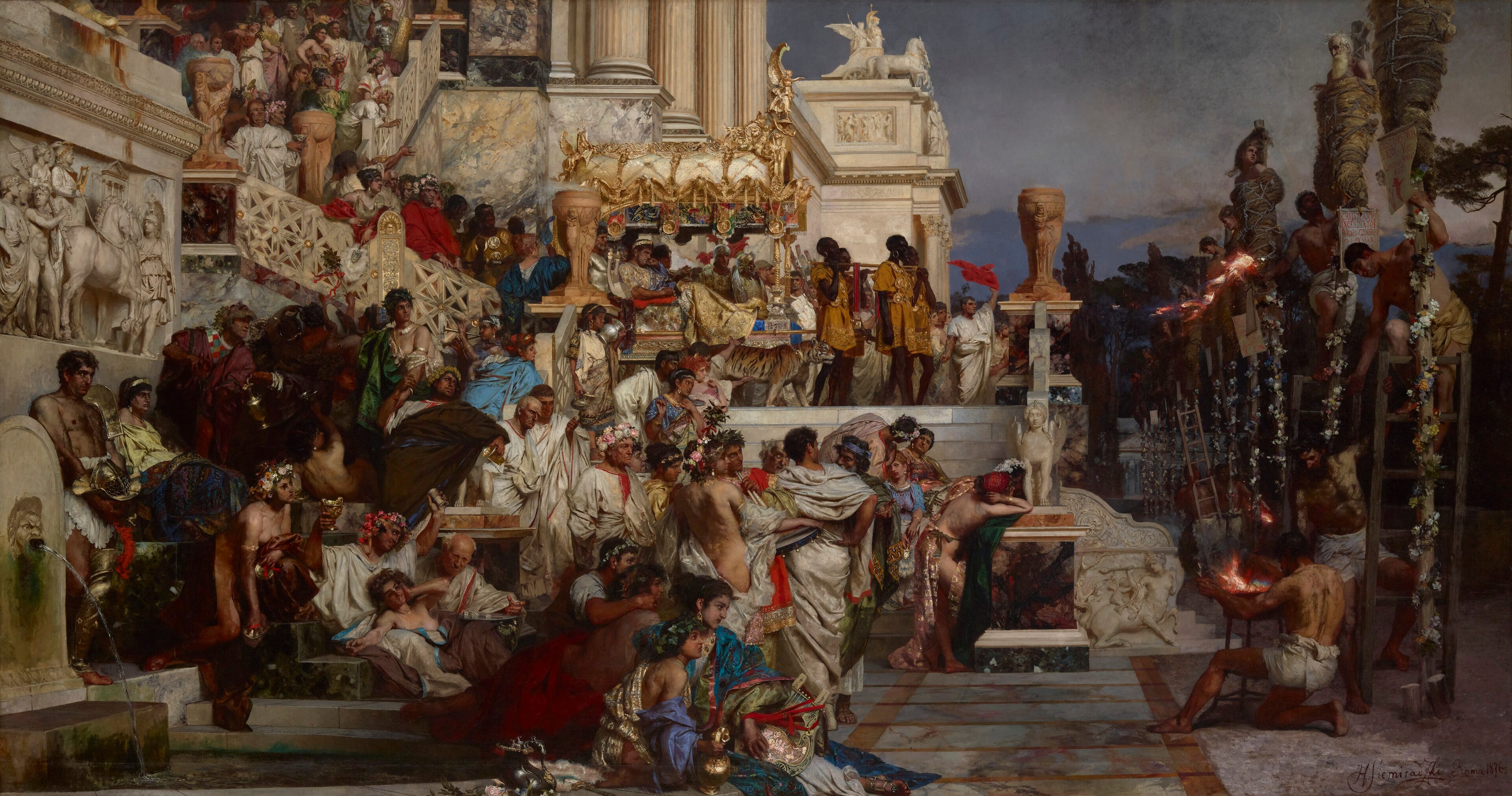
It is in the final, fifteenth book of the Annals that we find a reference both to Christianity and Christus. There, Tacitus is explaining how the Emperor Nero scapegoated a group called Christians for starting the fire of Rome:
‘Therefore, to squelch the rumor, Nero supplied (as culprits) and punished in the most extraordinary fashion those hated for their vice, whom the crowd called “Christians.” Christus, the author of their name, had suffered the death penalty during the reign of Tiberius, by sentence of the procurator Pontius Pilate. The pernicious superstition was checked for a time, only to break out once more, not merely in Judea, the origin of the evil, but in the capital itself, where all things horrible and shameful collect and are practiced… ’ (Annals 15.44)
Despite doubts in some quarters, the passage is generally considered authentic, in part due to the negative light in which Christianity is cast.4 Tacitus spares no words in describing Christianity: it is “pernicious superstition”, an "evil”, Christians are “hated for their vice” and their faith took hold where all shameful things do: Rome.
Christianity as a Superstitio
Like his friend Pliny (who may well be a source for his information about Christianity)5 it is notable that Tacitus characterises Christianity as a superstitio. Yet we should be careful not to import our modern understandings of the word ‘superstition’ back into the Latin superstitio.
In the way the term is used today, ‘superstition’ often refers to a perceived irrational religious belief. For example, a low-Church Protestant might describe a Catholic who crosses themselves or kneels before an altar, or someone who has an excess of religious credulity, as ‘superstitious’.
In the ancient Roman world, superstitio is to be contrasted with religio, the proper worship of the gods. Thus, to be superstitious was not simply to hold an irrational belief – it was to be socially deviant. This is the reason why Christianity is seen as such a threat in the ancient Roman world: its refusal to uphold the social order through the proper worship of the Roman gods.
As punishment for their ‘crime’, Nero had Christians ripped apart by dogs and set on fire upon crosses. This event was the most severe persecution Christians had faced up until this point in the Roman Empire. Its memory may explain why Mark – often thought to be a ‘Roman’ gospel – focuses so heavily on preparing its readers for persecution, and why 1 Clement recounts recent ‘calamities’.6
3. Suetonius
One of the most enigmatic and contested sources for Jesus outside the Bible is found in the Roman historian, Gaius Suetonius (c. 69-122 CE). Best known for his collection, Lives of the Twelve Caesars, Suetonius’ biography of the Emperor Caligula contains what is widely understood as a cryptic reference to Christ:
‘Since the Jews constantly made disturbances at the instigation of Chrestus, he expelled them from Rome’ (Claudius, 25).
This passage immediately raises questions. Who is this ‘Chrestus’? And what were these disturbances, which led to an expulsion of Jews from Rome in 49 CE?
For many scholars, Suetonius has made a two-fold blunder: ‘Chrestus’ is a misspelling of ‘Christus’, and it was his followers, not Chrestus, who were personally responsible for the troubles. Suetonius was referring to Jesus, but the fact that he has such a poor knowledge of these events only attests to how little he knew about him.
